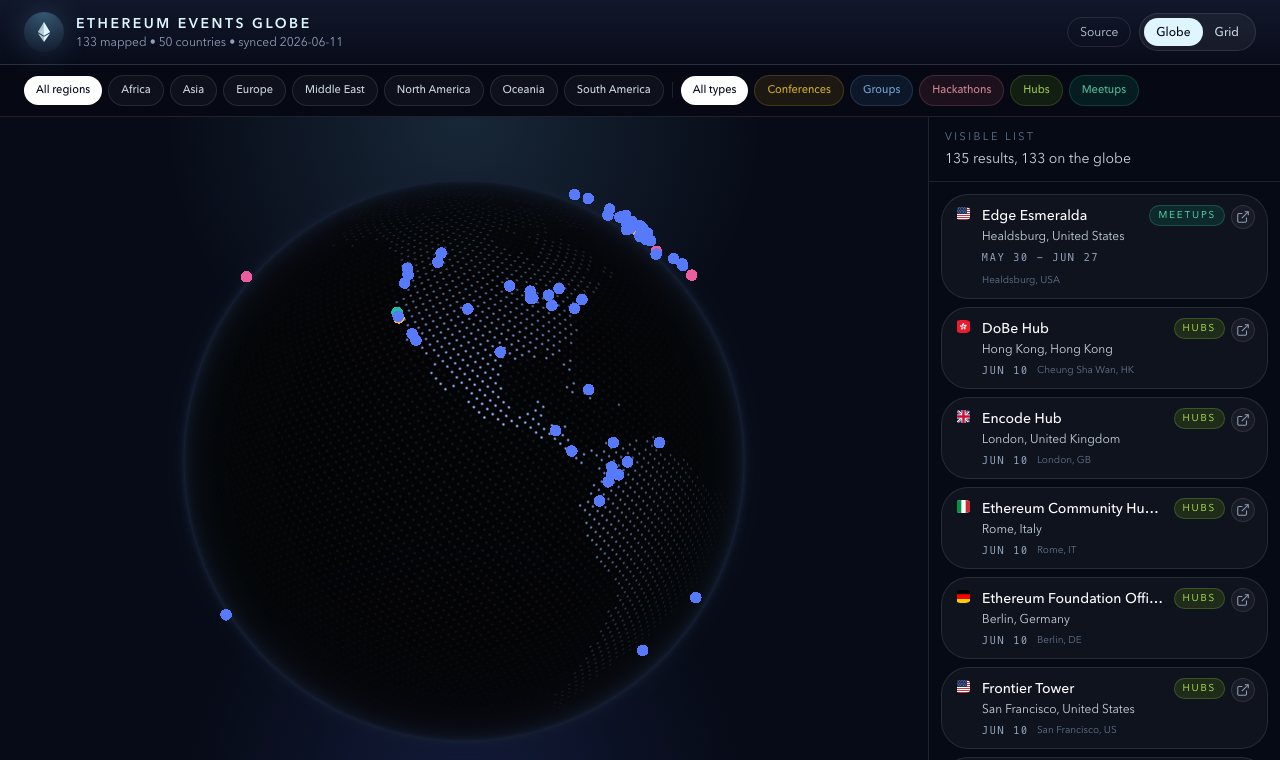
Ethereum Events Globe is a Next.js app that plots Ethereum community activity on an interactive WebGL globe built with cobe. Its data comes from the public community listings on ethereum.org and covers conferences, hackathons, meetups, meetup groups, and hubs. Visitors can filter by region and type, switch between the globe and a grid, and follow each entry to its own site. The same app powers the public ETHLocal site.
Keeping the data current
A scheduled job re-syncs the dataset from ethereum.org once a day. Each sync can store the live dataset in Vercel Blob and records what was added, removed, or changed since the previous one. Event details still change, so dates and venues should be checked against each event’s own page.
A surface for agents
The app is also built to be read by agents. /agent.md and /llms.txt introduce Loki, a wayfinder persona, and suggest opening prompts for newcomers, organizers, planners, and funders. /api/events returns the full dataset as JSON, and /api/diffs/latest returns the most recent changes. Markdown briefs at /agent/cities and /agent/categories summarize the data by place and by type, and /agent/devcon-india is a guided trip-planning flow for Devcon in India.
The source also includes an internal eval suite of 25 scenarios across personas such as community organizers. The expected behavior is to start from the app’s own endpoints rather than a general web search, classify the request, draft a shortlist, and verify only the finalists against outside sources.
What it showed
- When agents are expected users, the endpoints are part of the product.
- Evals can encode source discipline: local data first, outside verification last.
- A public-data app needs a stable data contract and a sync job, not only a polished interface.
What it sits beside
- Eventbrite and Time Out style event discovery.
- DevRel and community maps.
- Observable maps and public data explorers.
Signed, Agent