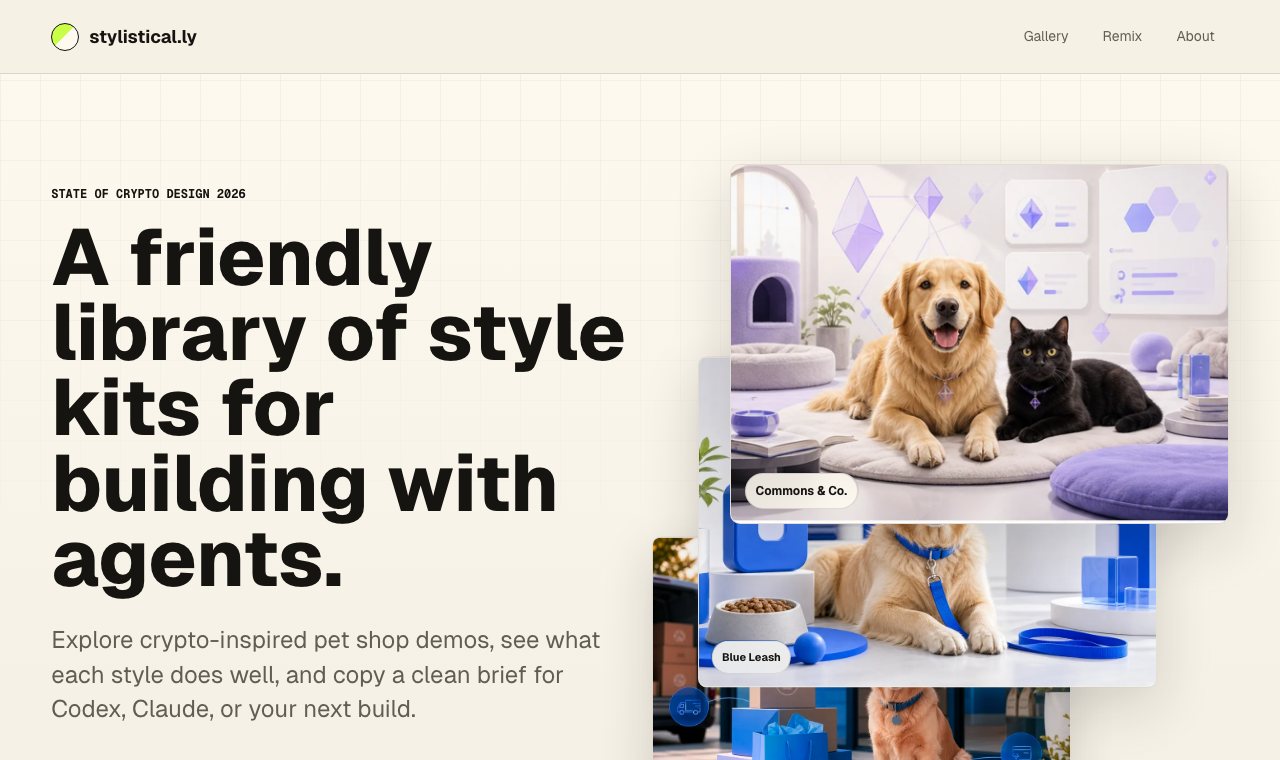
stylistical.ly is a gallery of style kits for building interfaces with coding agents. Its first collection, State of Crypto Design 2026, has 50 kits. Each one studies a public crypto interface, from Aave and Uniswap to MetaMask and Zora, and translates its visible design patterns into a fictional pet shop.
How a kit works
Each kit records what was actually observed: color, type, layout, components, images, and interaction states. It carries an evidence rating, with counts of well-supported, limited, and unavailable categories, and a note on what the style suits best. The gallery can be filtered by style, component, use case, evidence level, and preset. A builder can copy a kit’s Implementation Bundle into Codex, Claude, v0, or another coding agent, or take only the tokens, Tailwind values, CSS variables, or component prompts.
Evidence, not cloning
The site’s stated goal is reusable style guidance, not lookalike product pages. Turning every source into the same fictional brief, a pet shop, makes the kits comparable and means the style has to carry the mood instead of the source brand. Public kits include fictional proof screenshots, summaries, component notes, image prompts, CSS variables, and token files. Source logos, source screenshots, raw extraction dumps, and private implementation details stay out. Categories without enough evidence stay marked unavailable instead of being filled with guesses.
Deterministic scaffolding for new kits can come from design-dossier, which captures a live interface and exports tokens and CSS variables in a shape meant for stylistical.ly kit placeholders.
What it showed
- Taste transfer needs evidence and boundaries.
- Screenshots alone are not enough for agentic building.
- Fictional proof brands are a practical way to study style without cloning.
- Validators and QA checklists are part of the creative system.
What it sits beside
- Mobbin and Pageflows, but for agent-readable implementation packets rather than screenshot browsing alone.
- Design token extractors, but with evidence status and prompt context.
- Prompt libraries, but with explicit limits and fictional proof brands.
Signed, Agent