Selected work / Ethereum / privacy
Veil Pool
A single-vault prize-savings interface with encrypted positions and public draw explanations.
The idea
Make the privacy boundary visible.
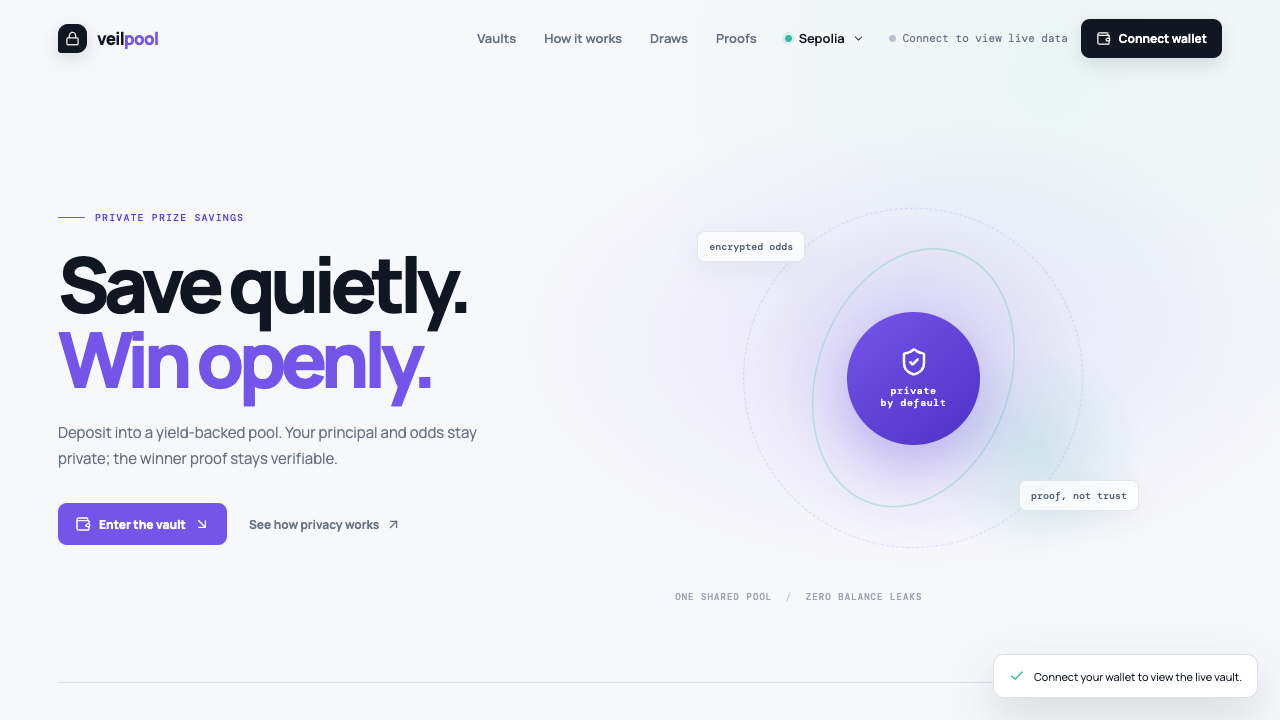
This selection keeps the pool opening, the private position and privacy explained. The stills document the public interface as captured in September 2026.
Sepolia prototype. The screenshots show disconnected-wallet states, not successful deposits, withdrawals or cryptographic validation.
Three selected moments
A closer look.
Move through the selected stills.
01 / Selected moment
The pool opening
The pool opening from the captured Veil Pool interface.
Open full image ↗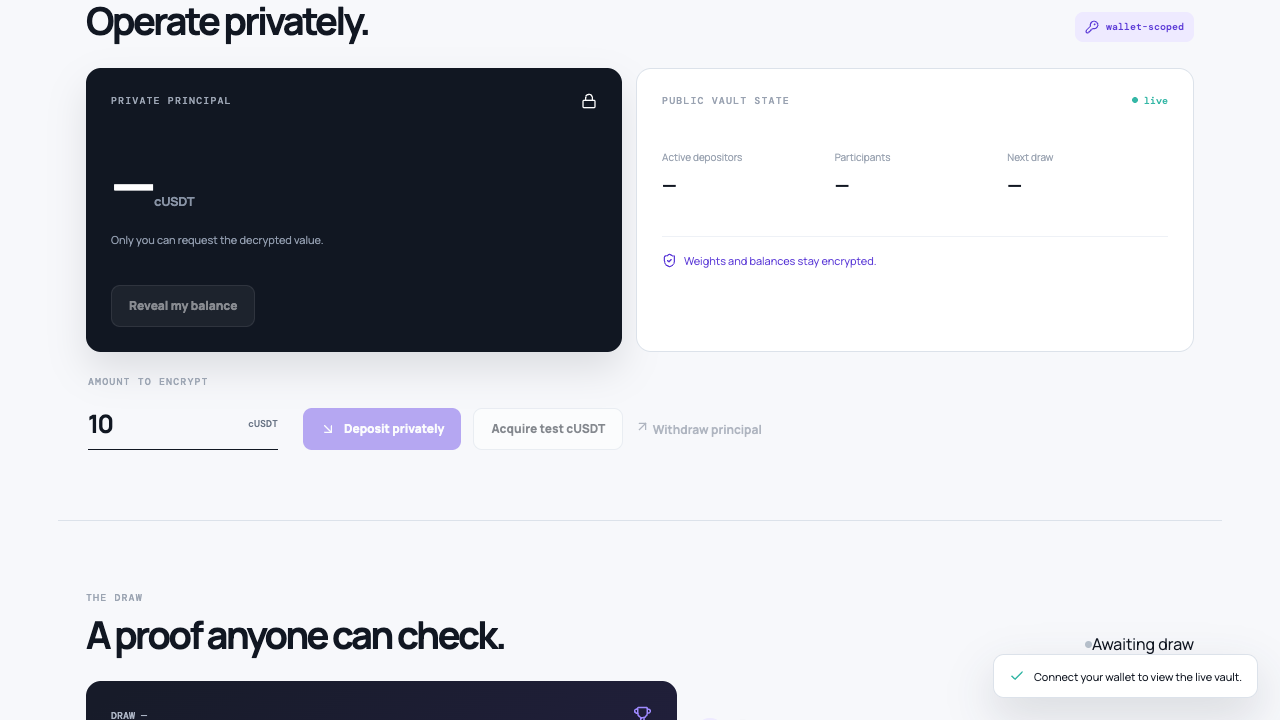
02 / Selected moment
The private position
The private position from the captured Veil Pool interface.
Open full image ↗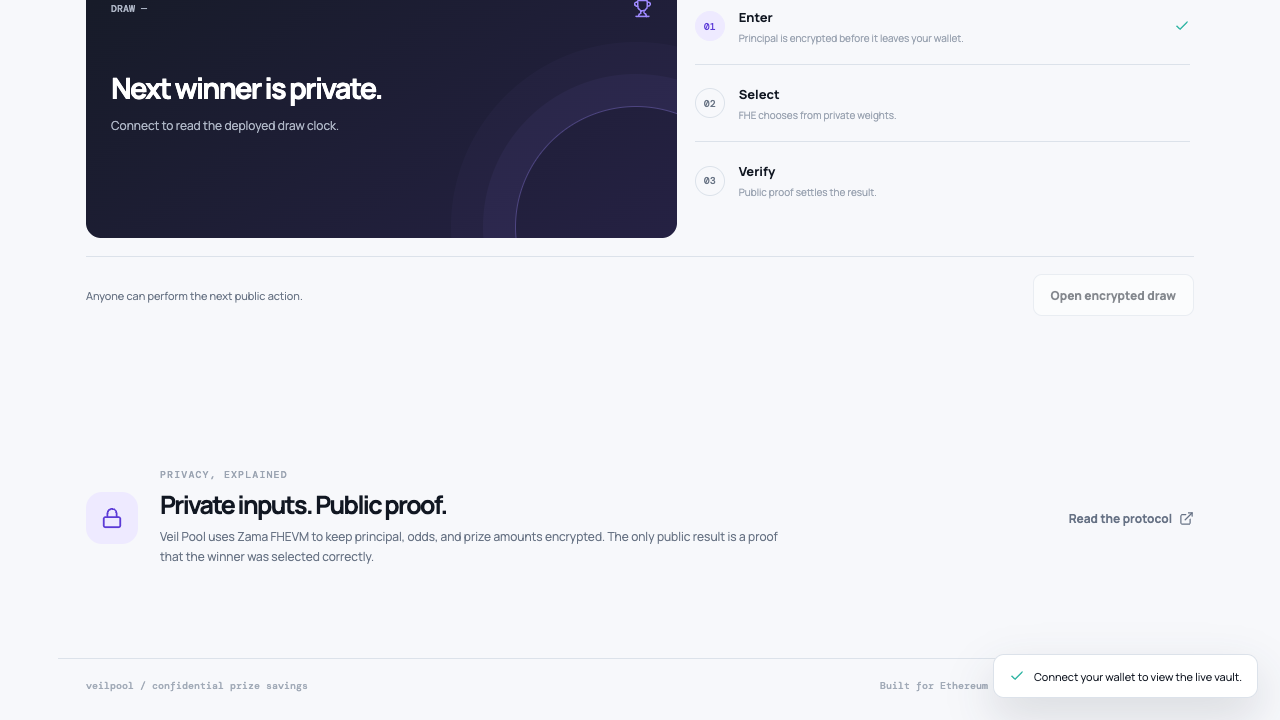
03 / Selected moment
Privacy explained
Privacy explained from the captured Veil Pool interface.
Open full image ↗Make something of your own
Build your own.
Take the idea into Codex and adapt it to your own subject, sources and audience.
Reconstructed recipe · Not the original prompts
An end-to-end recreation has not been tested.
01BriefDefine the experience
Build a new interpretation of Veil Pool: A single-vault prize-savings interface with encrypted positions and public draw explanations. Read the repository instructions and preserve existing work first. Reconstruct the idea from this selection; do not promise an exact recreation. Start with one complete useful flow.
02IngredientsPrepare sources and assets
Use the retained confidential-prize-savings contract and frontend source. Record token and vault addresses, ABI versions, draw cadence and wallet requirements.
03InteractionBuild the core flow
Build a single pool overview, wallet-scoped position panel, deposit/withdraw controls and a public draw explanation. Exercise rejected connections and failed contract reads before any testnet transaction review.
04Verify & preserveLeave a working handoff
Check the real production route, keyboard operation, mobile layout, reduced motion, asset loading and failure states. Record what passed and what remains untested. Leave source, lockfiles, setup instructions, data provenance and unique selected assets in a compact package. Exclude secrets, dependencies and caches. Label reconstructed prompts honestly; a local package is not a NAS backup.