Selected work / Ethereum / preservation
PoWeb
A POAP preservation utility that packages badge records, artwork and ownership evidence.
The idea
Keep the record portable.
This selection keeps the opening, the export form and the witness loop. The stills document the public interface as captured in September 2026.
The original advertises five-hour hosted job and ZIP retention. This selection does not contain user exports or prove archive correctness.
Three selected moments
A closer look.
Move through the selected stills.
01 / Selected moment
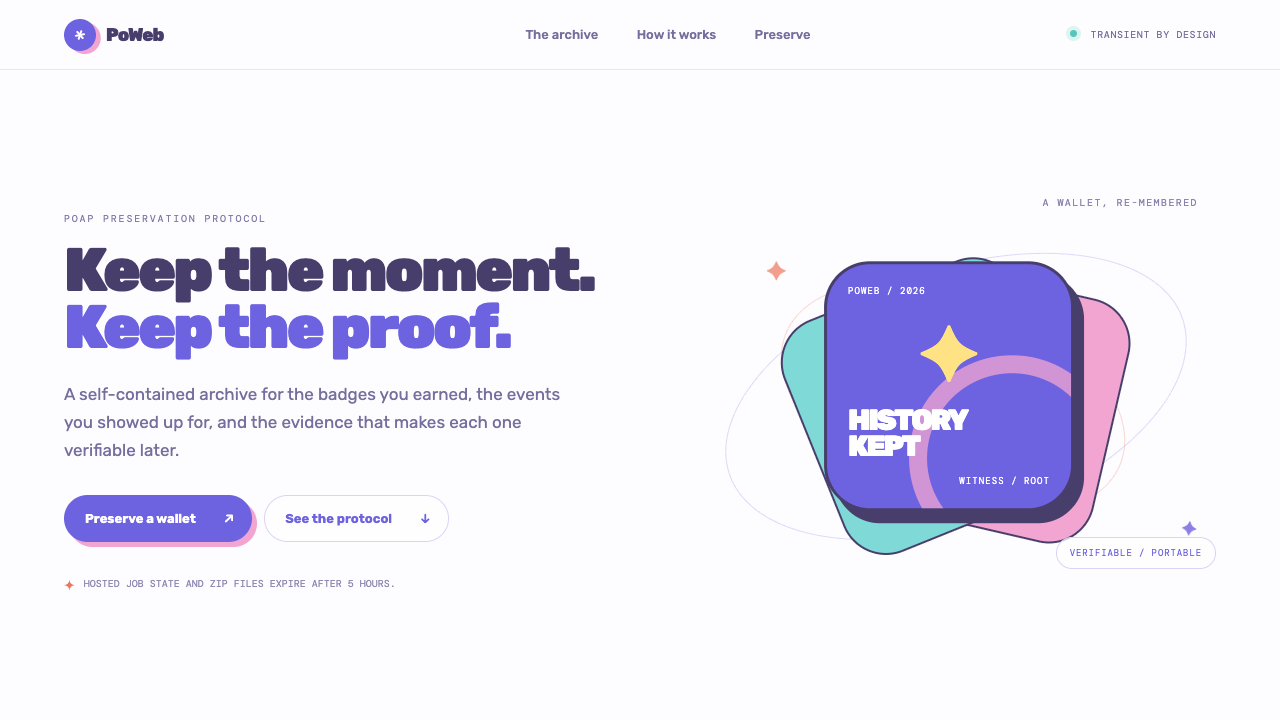
The opening
The opening from the captured PoWeb interface.
Open full image ↗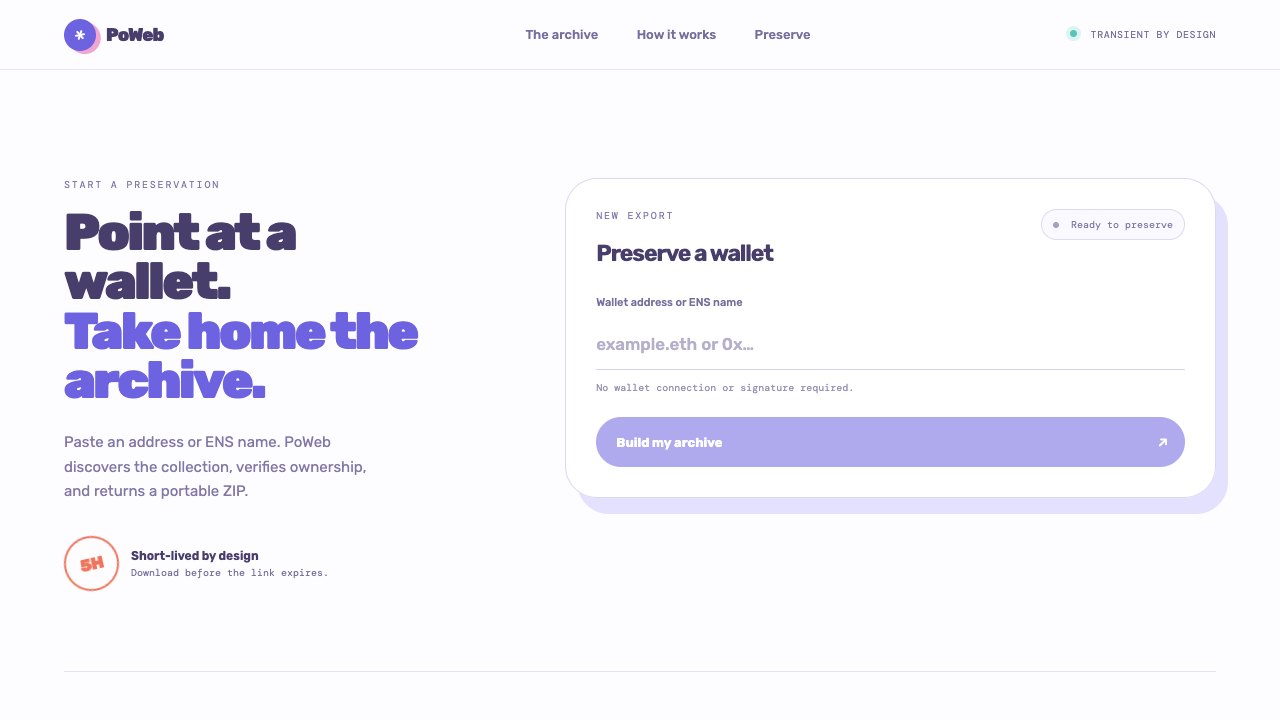
02 / Selected moment
The export form
The export form from the captured PoWeb interface.
Open full image ↗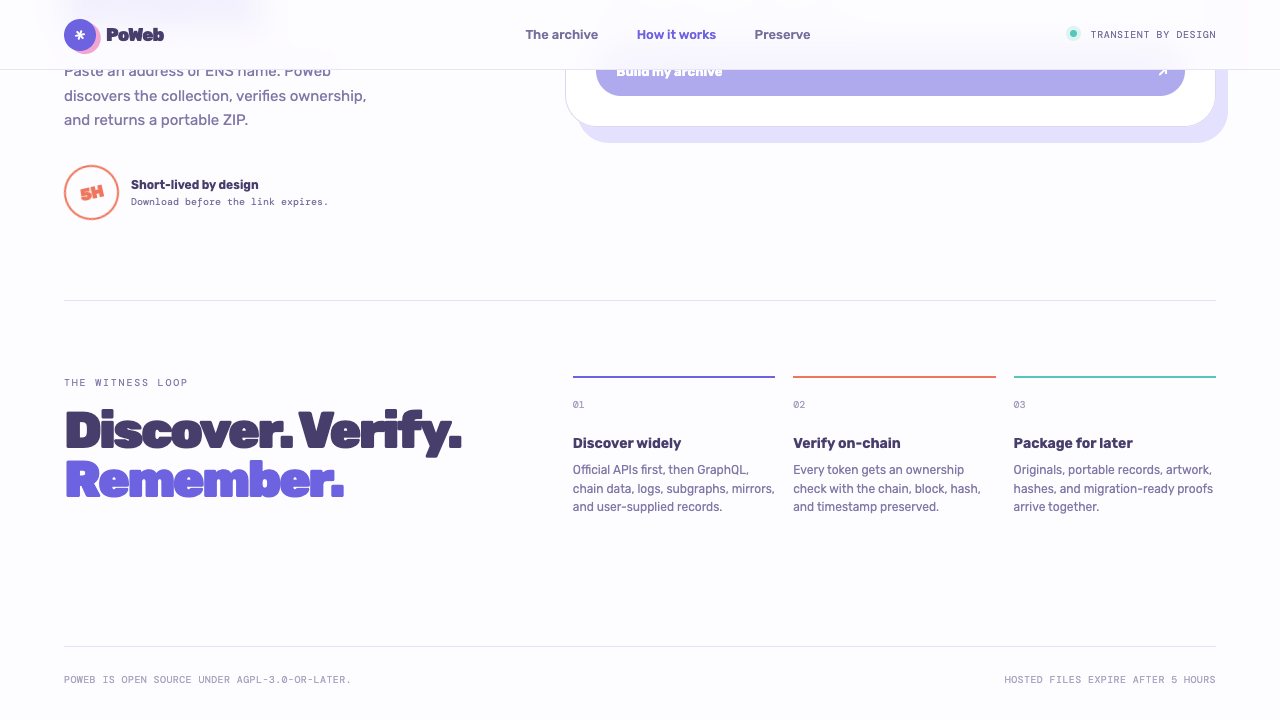
03 / Selected moment
The witness loop
The witness loop from the captured PoWeb interface.
Open full image ↗Make something of your own
Build your own.
Take the idea into Codex and adapt it to your own subject, sources and audience.
Reconstructed recipe · Not the original prompts
An end-to-end recreation has not been tested.
01BriefDefine the experience
Build a new interpretation of PoWeb: A POAP preservation utility that packages badge records, artwork and ownership evidence. Read the repository instructions and preserve existing work first. Reconstruct the idea from this selection; do not promise an exact recreation. Start with one complete useful flow.
02IngredientsPrepare sources and assets
Define normalized POAP records, raw source responses, media hashes, chain/block provenance and a versioned manifest. Use the retained source as a starting point and document API and temporary storage dependencies.
03InteractionBuild the core flow
Implement discovery, ownership verification, packaging and offline verification as separate steps. Verify one authorized public collection end to end, including partial-source failures and reopening the downloaded archive after hosted expiry.
04Verify & preserveLeave a working handoff
Check the real production route, keyboard operation, mobile layout, reduced motion, asset loading and failure states. Record what passed and what remains untested. Leave source, lockfiles, setup instructions, data provenance and unique selected assets in a compact package. Exclude secrets, dependencies and caches. Label reconstructed prompts honestly; a local package is not a NAS backup.